
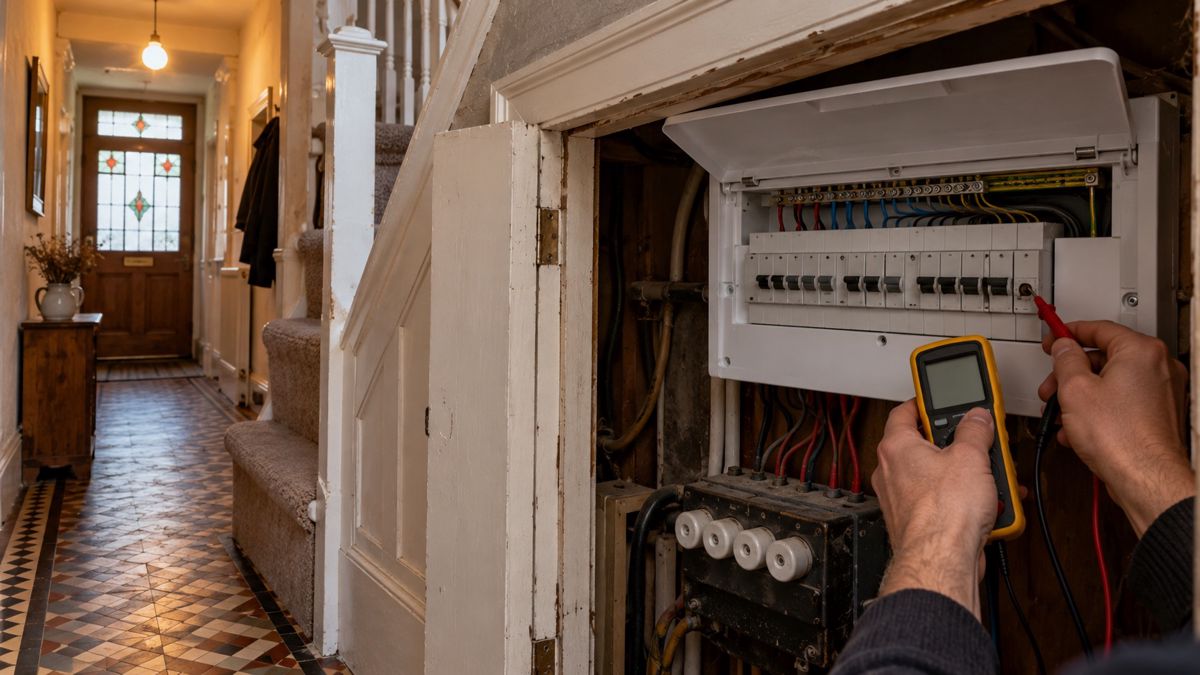
For most Manchester homes, a straightforward consumer unit replacement costs somewhere in the hundreds of pounds, not thousands. A rough guide for an ordinary house is about £400 to £900, and more where extra work is needed. Those are general UK market figures, not a quote from Manchester Electricians Pros. Your own price depends on the points below.
You may have seen the phrase 200 amp electrical panel upgrade online. That is a US term. In UK homes the part is called a consumer unit, or fuse box, and the supply into most houses is a single-phase connection with a main fuse of around 60 to 100 amps. So when people search for an electrical panel upgrade in Manchester, they usually mean a new consumer unit.
What is a consumer unit and why replace it?
The consumer unit is the box that splits the incoming supply into separate circuits for lights, sockets, the cooker and so on. It also holds the switches and protective devices that cut the power when something goes wrong.
Older boxes may have rewirable fuses or no RCD protection. An RCD switches off very quickly if electricity leaks to earth, for example through a person, which is why modern units are designed around it. Current rules also expect a non-combustible (usually metal) enclosure in homes.
Common reasons to replace one:
- The existing unit is old, cracked or has rewirable fuses.
- An inspection report (EICR) has flagged it as unsatisfactory.
- You are adding an EV charger, a shower or a new kitchen and the old unit has no spare ways.
- The unit keeps tripping or shows signs of heat.
What is a rough price range for a new consumer unit?
Treat these as rough UK guides only. Prices vary by firm and by house, and they change over time.
- A like-for-like swap in an ordinary home, with a standard number of circuits: often around £400 to £900.
- A larger home, more circuits or a unit with extra protection such as surge protection: commonly higher, sometimes £1,000 or more.
- A swap that uncovers other faults, for example poor earthing or damaged cables: the extra repairs are priced on top.
If a number sounds far lower than the rest, ask what it leaves out. A very cheap quote can mean no testing, no certificate or a plastic unit that does not meet current rules.

What changes the price of the job?
Two homes with the same box on the wall can get very different quotes. These are the main factors.
The unit itself
The brand, the number of ways, the type of RCDs or RCBOs fitted and whether surge protection is included all change the cost of the parts.
The condition of what is already there
The electrician has to test the circuits before and after the swap. If the testing shows damaged cable, missing earthing or loose connections, those need fixing. Pre-1960s homes in Manchester turn up more of this than newer ones.
Access and location
A unit in a hallway cupboard is quick to reach. One in a cellar, under tight stairs or behind a built-in cupboard takes longer, and may need the meter tails (the thick cables from the meter) lengthened or replaced.
Extras you add at the same time
Many people add an EV charger circuit, an outside socket or new lighting circuits while the power is already off. That saves a second visit but makes the quote bigger.
What does the work involve and how long does it take?
A standard replacement is often finished in a single day, though larger or trickier jobs can take longer. Ask the electrician for an estimate on your own house.
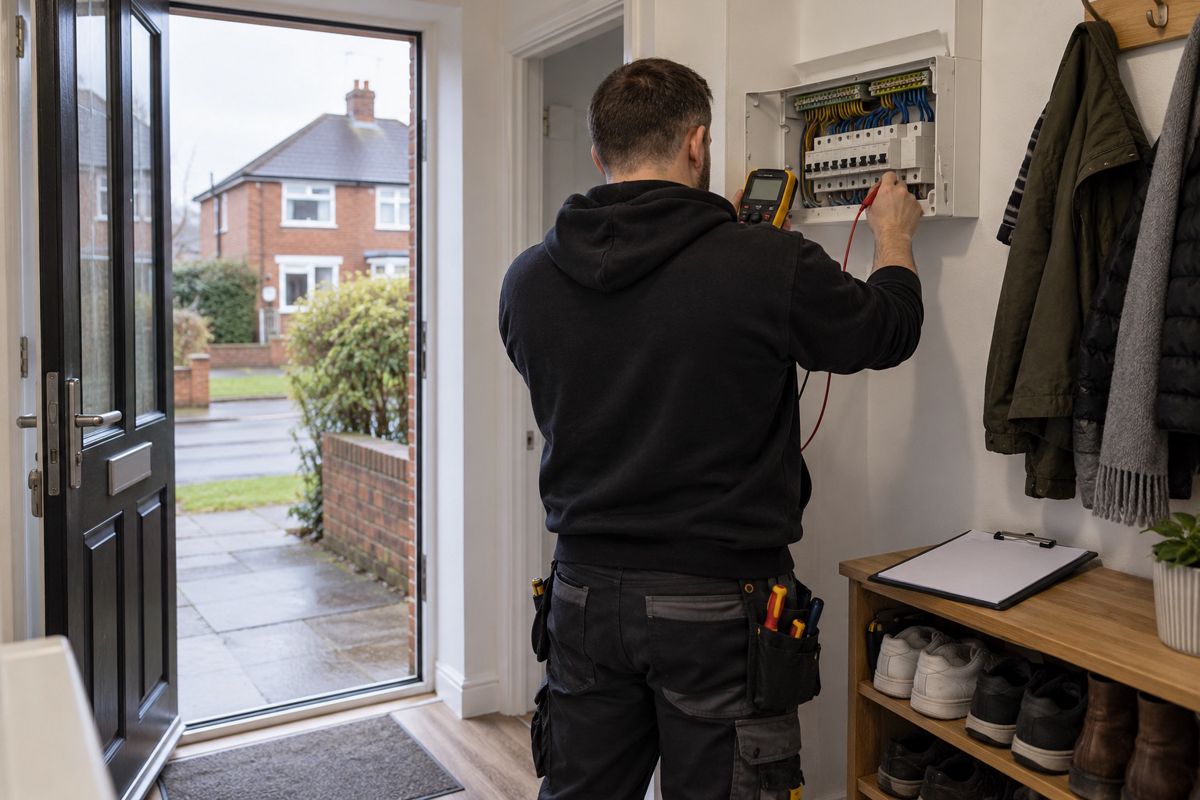
- The electrician inspects the existing unit, the tails and the earthing and bonding.
- The power is switched off for part of the day. Plan around fridges, freezers, broadband and anything medical that depends on mains power.
- The old unit is removed, circuits are labelled and connected to the new one.
- Every circuit is tested, and the results are written up.
- You are shown how to reset the switches and where the main switch is.
In England this kind of work is covered by Part P of the Building Regulations. That normally means it is either carried out by an electrician registered with a competent person scheme, or reported to building control. You should receive an electrical installation certificate and a notification confirmation afterwards. Ask for both and keep them with your house papers.
What do Manchester homes tend to need?
The city has a big mix of housing, so there is no single answer. Some patterns are common.
- Victorian and Edwardian terraces: original wiring may be long gone or partly replaced, and a consumer unit often sits in a cellar or under the stairs.
- 1930s semis in places like Chorlton, Sale and Prestwich: often updated once or twice, with mixed cable ages behind the walls.
- Post-war and later estates: more regular layouts, but older fuse boards are still around.
- Rented homes and flats: landlords in England must have the electrics inspected at least every five years, and a poor report can lead to a new unit.
Damp is a factor too. Moist cellars and outside walls are hard on metal parts, so a good electrician will look for corrosion while the box is open.
How do I compare quotes sensibly?
Get at least two quotes in writing, and compare what is in them rather than just the total.
- Does the quote include testing, a certificate and Part P notification?
- Is the unit metal, with RCD protection on the circuits? Which type?
- Is surge protection included or optional?
- What happens if the electrician finds other faults? Who agrees the extra cost, and when?
- Is there a registered competent person scheme behind the work? Check the scheme's online register yourself instead of relying on a logo.
Be careful with anyone who will not put a price in writing, asks for the full amount up front, or says the job needs no paperwork.
Where to go next
If you are weighing up a new unit, our page on electrical panel upgrades in Manchester explains how we approach the job and what to expect on the day. If the wiring behind the box is old as well, read about house rewiring. You can also ask Manchester Electricians Pros for a written quote on your own home.